

The Role of Oak in Wine
“Aged in oak barrels,” “barrel-aged,” “oaky notes”… most of us have come across these terms on a wine label at some point.
But what exactly does oak do to wine?
Before answering that question, it’s worth taking a step back. To understand oak’s impact, we first need to look at the history of the barrel, what a barrique actually is, and what it concretely brings to the winemaking process.
The History of the Barrel
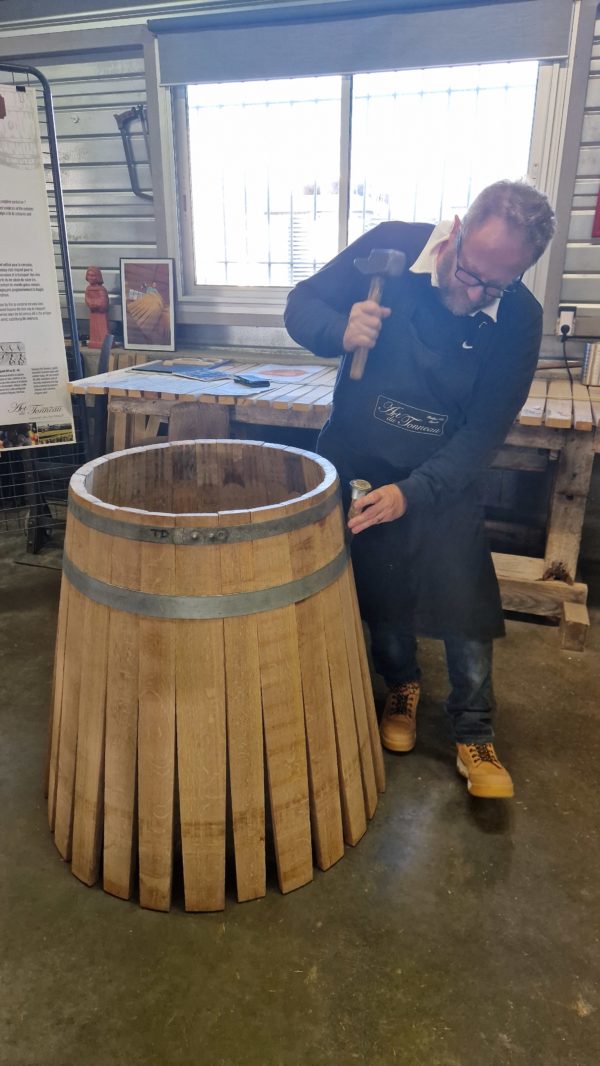
Wooden barrels are more than 2,000 years old. Their invention is generally attributed to the Gauls or the Celts. The Gauls sometimes used them as incendiary weapons during conflicts with the Romans—but more importantly, they used them to transport food and goods of all kinds.
The Romans, who relied primarily on clay amphorae, quickly recognized the advantages of barrels: they were sturdier, easier to transport, and more practical to store.
Aside from the addition of metal hoops, the fundamental manufacturing process has barely changed in two millennia. For centuries, the barrel’s dominance was unquestioned.
But in the 1960s and 1970s, that supremacy was challenged. New containers made from alternative materials entered the market. In the wine world especially, stainless steel tanks began replacing traditional oak barrels, offering winemakers greater control over temperature and hygiene.

Which Type of Wood?
You may occasionally come across wines aged in acacia, chestnut, or even cherry wood—such as in Italy’s Valpolicella region. But when it comes to barrels, oak is king.
Oak offers several key advantages:
Easy to split along the grain (rather than sawn), preserving its structure
Flexible enough to be bent into barrel shape
Strong and durable
Naturally insulating
Slightly porous, allowing controlled oxygen exchange during aging
Contributes aromatic complexity
French oak enjoys the strongest reputation worldwide. French coopers export roughly 70% of their production, reflecting the global demand for their craftsmanship.
The most renowned French forests for barrel production are located in central France (Allier, Nevers, Limousin) and in the Vosges. Several oak species grow in these regions, but the two primarily used in French cooperage are:
Quercus petraea (sessile oak)
Quercus robur (pedunculate oak)
Each species—and even each forest—can influence the grain, tannin profile, and aromatic contribution of the barrel, subtly shaping the wine it ages.
Quercus petraea, notably found in the prestigious Tronçais Forest, is considered one of the finest sources of French oak for cooperage. Although the forest had been managed for centuries, it was significantly developed under Jean-Baptiste Colbert, minister to Louis XIV, beginning in 1670. His goal was to secure high-quality timber for the Royal Navy’s shipbuilding needs.
While the forest is no longer as vast as it once was—historically estimated at around one million hectares—it still spans more than 10,000 hectares today.
Sessile oak (Quercus petraea) is known for its fine grain. The concept of grain refers to the growth pattern of the tree, which occurs in two main phases:
Spring growth, when the tree channels nutrients from the roots to the leaves. This phase is relatively similar across oak species.
Summer growth, driven by canopy photosynthesis. This phase varies depending on the tree, climate, and weather conditions.
For example, hotter and drier conditions tend to produce wider, coarser grain.
The fine grain of sessile oak yields more refined tannins and contributes subtle, elegant aromatic complexity to wine.
By contrast, Quercus robur (pedunculate oak) typically has a coarser grain, which can result in a more pronounced tannic structure and a slightly different aromatic expression.
Left: Quercus petraea (fine grain) — Right: Quercus robur (coarse grain).
What Impact Does Oak Have on Wine?
1. Greater Stability
Wine aged in barrel first gains structural stability.
Barrels are slightly porous. Wine slowly “breathes” through the staves (the wooden planks forming the barrel). This very gradual oxygen exposure triggers a controlled micro-oxidation process.
A small portion of ethanol (the main alcohol in wine) oxidizes into acetaldehyde. This compound acts as a bridge between:
Anthocyanins (color pigments in red wine)
Tannins (responsible for structure and astringency)
As these components bind together:
Color becomes deeper and more stable
Tannins soften
The wine gains roundness and balance
This color intensification is desirable in red wines. In whites, however, oxidation can lead to browning, which is why clarification (“fining”) may later be used to correct it.
2. Tannin Contribution
Barrel aging doesn’t just soften tannins—it can also add them.
The amount depends on:
The oak species
The grain (fine vs. coarse)
The seasoning process (oak staves are air-dried outdoors for 2–3 years before coopering)
Some wines benefit from these additional tannins. Others do not.
Take Syrah, for example. Naturally rich in tannin, it often doesn’t need more structure. Winemakers may therefore choose:
Used barrels (which contribute little to no additional tannin)
Alternative vessels such as concrete tanks
Oak is never neutral. Its use is always a stylistic decision, balancing structure, texture, and aromatic expression depending on the grape and the desired profile.
Barrel aging also comes with loss. Through the staves, the bung hole (the opening used to fill the barrel), and the joints, wine not only breathes—it slowly evaporates. This is known as the “angel’s share.” It typically represents around 2% volume loss per year.
The main elements that evaporate are water and alcohol. While this results in a decrease in volume, it also leads to a concentration of aromas and structure.
Aromatic Complexity and Toasting
One of the primary reasons winemakers choose barrel aging is the gain in aromatic complexity. A key factor influencing these aromas is the toasting level of the barrel.
During production, the barrel is heated over a fire to make the staves pliable and allow them to bend into shape. The intensity of this heating—known as “toasting”—determines the aromatic impact on the wine.
We generally refer to:
Light toast
Medium toast
Heavy toast
In reality, coopers offer dozens of toast variations.
Light toast imparts subtle notes such as clove or forest floor. In regions like Burgundy, where Pinot Noir is naturally delicate, winemakers often favor lighter toast to preserve fruit purity.
Medium toast tends to produce more noticeable vanilla and sweet spice notes.
Heavy toast delivers what are known as empyreumatic aromas—smoke, roasted coffee, toasted bread, caramel, and pronounced spice.
The stronger the toast and the higher the proportion of new oak, the more concentrated and powerful the wine needs to be. If the wine lacks structure or depth, the oak can dominate it entirely—resulting in what is sometimes bluntly referred to as “wood juice.”

Matthieu Aravantinos, DipWSET
Sommelier & Wine Merchant, Dijon
