

Choosing the Wines of Your Wedding
What Should You Serve at Your Wedding Cocktail Hour?
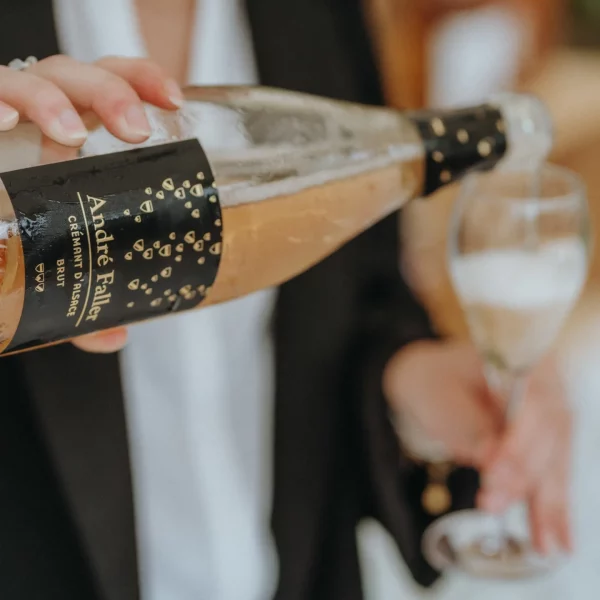
A wedding must —whether you’re a wine enthusiast or not—is sparkling wine. Some couples insist on Champagne, while others look for more budget-friendly alternatives like Crémant.
Champagne producers will rightly argue that excellent bottles can be found at reasonable prices—particularly from areas such as the Côte des Bar. And that’s true.
For our own wedding, we chose fresh, easy-drinking sparkling wines that emphasized roundness over complexity: Alsace Crémant, both white and rosé. They were refreshing, accessible, and a hit with everyone.
If your wedding day turns out warm and sunny, it’s wise to offer a rosé option as well. There will always be guests who prefer still wine over bubbles.
And if you’re celebrating in Burgundy and want to honor tradition, you might serve a white wine for Kir. Just one recommendation: please don’t use a Grand Cru for it.
What About the Reception Dinner?
For the seated meal, you’ll typically need one wine for the starter and another for the main course.
Contrary to popular belief, it doesn’t really matter whether you start with white or red. What truly matters is:
That each wine pairs well with the dish it accompanies.
That the first wine served is not more powerful or fuller-bodied than the second.
Balance and progression are key. You want the wines to enhance the food—and to build naturally in intensity throughout the meal, rather than overpowering the palate too early.
In general, it’s impossible to find a single wine that pairs perfectly with every cheese and pleases every guest. Accepting that reality makes the decision much easier.
And for dessert?
Once again, it depends on what’s being served—especially since the traditional croquembouche is no longer every couple’s first choice.
Because sweet wines aren’t universally appreciated, I often recommend returning to sparkling wine. It refreshes the palate and gives guests a burst of energy before the dance floor opens. Just make sure you’ve checked the venue’s closing time—no responsibility taken for an endless celebration.
A touch of sweetness works well with dessert. You might opt for a Champagne ranging from Brut to Sec (roughly 6 to 32 grams of sugar per liter). Keep in mind that by the end of the meal, your guests’ palates won’t be as sharp as they were at the beginning. Serving a highly nuanced vintage Champagne at this stage may not be the most strategic choice.
How Much Wine Do You Need for a Wedding?
Cocktail Hour
Quantities depend on what other alcoholic beverages you’re serving.
If you plan to offer sparkling wine alongside beer, spritzes, punch, or cocktails, you can estimate one glass per guest for the cocktail hour.
Seated Dinner
For the meal, a common guideline is:
1 bottle for every 6 guests
Which equals roughly one 125 ml (4 oz) glass per adult
This is an average and assumes moderate consumption.
Average Quantities for 100 Guests
Based on the 1 bottle per 6 guests rule:
Cocktail hour: 17 bottles
Starter: 17 bottles
Main course: 17 bottles
Cheese course: 17 bottles
Dessert: 17 bottles
Of course, these numbers should be adjusted depending on your crowd. If your guests are enthusiastic wine drinkers, you may want to increase quantities slightly. If many prefer cocktails or beer, you can scale back accordingly.
You may have already done the math and realized that the total comes close to one bottle per guest. Keep in mind that not everyone drinks the same amount—and some guests won’t drink at all (pregnant women, designated drivers, etc.). These figures are simply averages. For some weddings, they’ll feel generous; for others, they may seem tight.
The advantage of wine over food is simple: it keeps. It’s wise to plan for an extra 5% to 10% beyond your initial estimate.
If bottles remain unopened, you can:
Enjoy them later
Keep a few as keepsakes
Gift them to your guests
Golden Rules for Choosing Your Wedding Wines
Please your guests—but prioritize your own tastes. It’s your wedding.
Accept that not every pairing or bottle will win unanimous approval. Everyone’s palate is different.
Order slightly more than you think you need. It won’t go to waste.
And if you’d like guidance selecting the perfect wines for your big day, reach out to your trusted wine merchant in Dijon—The Wine Compass.

Matthieu Aravantinos – DipWSET
