

What Is Wine Made Of?
“Wine is the most civilized thing in the world,” wrote François Rabelais.
It is “the child of the sun and the earth,” said Paul Claudel.
Beautiful words. But they don’t really tell us what wine actually is.
The goal of this article is to break it down in simple terms—so you understand exactly what’s in your glass when you enjoy the fruit of your favorite winemaker’s work.

You’ve probably heard that Georgia is the birthplace of wine. Or perhaps Turkey. Or even Armenia. While it’s difficult to pinpoint one exact location, most archaeological evidence points to the Caucasus region around the 6th millennium BCE.
From there, viticulture spread eastward into Persia (modern-day Iran) and south toward Egypt. But it was to the west that wine truly took root—both culturally and commercially. In ancient Greece, wine became central to daily life and trade. The Romans then expanded vineyard cultivation across their empire, planting vines throughout much of Europe.
Thanks to Greek influence and Roman conquest, wine became deeply embedded in European civilization—laying the foundation for the wine cultures we know today.
The dictionary definition is straightforward: a fermented beverage made from fresh grapes or grape juice.
But let’s go a bit further.
Once harvested, grapes are brought to the winery and placed into tanks. They are crushed, and depending on the style of wine being produced, handled differently:
For white wines, the juice is typically separated from the skins before fermentation.
For red wines, the juice remains in contact with the skins, which gives the wine its color, structure, and tannins.
Then fermentation begins.
Yeast—whether naturally occurring on the grapes or added by the winemaker—consumes the sugars in the fruit and converts them into alcohol. This process also produces carbon dioxide and a wide range of flavor and aroma compounds that shape the wine’s character.
From that moment on, we are no longer talking about grape juice. We are talking about wine.
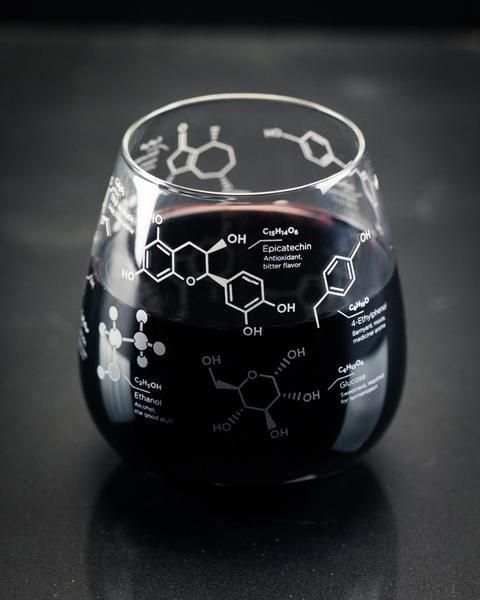
Water
Since grape juice itself is primarily water, it logically makes up the largest proportion of wine. While the exact percentage varies depending on the style, water accounts for roughly 85% of the final product.
Alcohol
Typically ranging between 11.5% and 14.5% ABV, alcohol is the second most significant component. The primary alcohol in wine is ethanol.
Alcohol influences several sensory perceptions:
A subtle impression of sweetness
Sometimes a slight bitterness
A warming sensation on the palate
It also plays a major role in a wine’s body. Generally speaking (though not as an absolute rule), lower-alcohol wines tend to feel lighter, while higher-alcohol wines often feel fuller-bodied.
The alcohol level depends on sugar concentration in the grapes at harvest. The more sugar present, the higher the potential alcohol after fermentation. That’s why wines from warmer, sunnier climates—where grapes ripen more fully—often show higher alcohol levels.
Acids
Roughly two-thirds of a wine’s acids come directly from the grapes themselves, primarily tartaric and malic acids. Other acids, such as lactic and acetic acid, are formed during alcoholic and malolactic fermentation.
Acidity is responsible for that mouthwatering sensation on the sides of your tongue. It gives wine freshness and vibrancy, while also providing balance—especially in sweet or high-alcohol wines.
Acidity is a key structural element. It contributes to a wine’s aging potential and plays a critical role in food pairings. Without sufficient acidity, a wine can feel flat or heavy.
Tartaric and malic acids tend to create sharper acidity. If malic acid levels are considered too high, winemakers may trigger malolactic fermentation, during which naturally occurring lactic acid bacteria convert malic acid into softer lactic acid. This process reduces sharpness and adds roundness and creaminess.
Nearly all red wines undergo malolactic fermentation, which is one reason white wines often seem more acidic by comparison.
Total acidity in wine typically ranges between 5.5 and 8.5 grams per liter.
Aromas
This is one of the most complex—and fascinating—components of wine. Aromas come from multiple sources.
Varietal aromas
These originate directly from the grape variety itself.
Pyrazines are responsible for green bell pepper or asparagus notes in Cabernet Sauvignon and Sauvignon Blanc.
Rotundone gives Syrah (Shiraz) and Austrian Grüner Veltliner their distinctive peppery character.
Most of these aromatic compounds are found in the grape skins. Some molecules are “dormant” at first—they are not aromatic in their initial state but reveal themselves during fermentation. These are known as aroma precursors.
Terpenes, for example, are responsible for the intense floral and fruity expression found in varieties such as Muscat and Gewürztraminer.
Fermentation aromas
Fermentation triggers complex chemical reactions that create new aromatic compounds not originally present in grape juice.
The famous banana and bubblegum notes in Beaujolais Nouveau come from isoamyl acetate, an ester formed during fermentation.
Acetaldehydes, produced through the oxidation of ethanol, are often considered a flaw—but in specific styles such as Jura’s Vin Jaune or Andalusian Sherry, they contribute desirable walnut and dried apple aromas.
Malolactic fermentation, which softens acidity by converting malic acid into lactic acid, also produces diacetyl—responsible for buttery notes often found in certain Chardonnays.
Lees (dead yeast cells) contribute pastry, brioche, and bread-dough aromas, commonly associated with Champagne and other traditional-method sparkling wines.
Aging aromas
Oak aging introduces additional aromatic layers:
Vanilla
Coconut (more common with American oak)
Smoke
Toast
Sweet spices
Over time, all these aromatic families evolve. As wine ages, it gradually develops what is known as a tertiary profile, with notes such as:
Game
Forest floor
Mushroom
Honey
Caramel
Leather
Environmental influence
Some aromas can also come from external environmental factors. For example, eucalyptus trees planted near certain Australian vineyards can deposit eucalyptol compounds on grape skins—sometimes strongly expressed in Cabernet Sauvignon from Coonawarra.
And if you’ve ever detected hints of lavender in certain wines from Provence, that may not be your imagination either.
Residual Sugar
Yeast converts grape sugars into alcohol during fermentation. However, yeast cells typically die before consuming all the available sugar, leaving a small amount behind. That remaining sugar is what determines whether a wine is labeled dry or sweet.
Under European standards, sweetness levels are generally classified as:
Dry: less than 4 grams per liter
Off-dry: 4 to 12 grams per liter
Medium sweet: 12 to 45 grams per liter
Sweet: more than 45 grams per liter
There are exceptions. Wines with very high acidity—Riesling is a classic example—can exceed these thresholds while still being perceived (and labeled) as less sweet, because acidity counterbalances sugar on the palate.
Glycerol
Glycerol is a naturally occurring, slightly sweet compound produced during fermentation. It contributes to a sense of roundness and sometimes viscosity, enhancing the wine’s texture and mouthfeel.
It is present in higher concentrations in botrytized sweet wines such as Sauternes or Tokaji, where it adds richness and a silky quality.
Phenolic Compounds
Anthocyanins are the pigments responsible for the color of red and rosé wines. They come from grape skins. Since white wines are usually fermented without extended skin contact, they contain little to no anthocyanins.
Tannins are responsible for the drying, astringent sensation often associated with red wines—particularly those from regions like Bordeaux’s Médoc. They can originate from:
The grape skins (generally the most desirable source)
The seeds (which can contribute harsher, more bitter tannins)
The stems (if not fully ripe, they may also impart green, bitter tannins)
You’ve probably heard that red wine is considered “healthier” than white wine. This idea largely stems from its higher concentration of phenolic compounds, many of which have antioxidant properties.
These compounds also contribute to a wine’s aging potential. As a result, red wines—thanks to their phenolic structure—tend to have a longer lifespan than most white wines.

I hope this article has sparked your curiosity and encouraged you to dive deeper into the world of wine.
And if you’d like to put this knowledge into practice, stop by your favorite wine shop in Dijon for a tasting session.
Cheers,
Matthieu Aravantinos, DipWSET
